Water Heater Replacement in Carrollton and North Dallas–Fort Worth
- Licensed Texas plumbers
- Gas and electric, tank and tankless
- Same-day visits when the schedule allows
When replacement beats repair
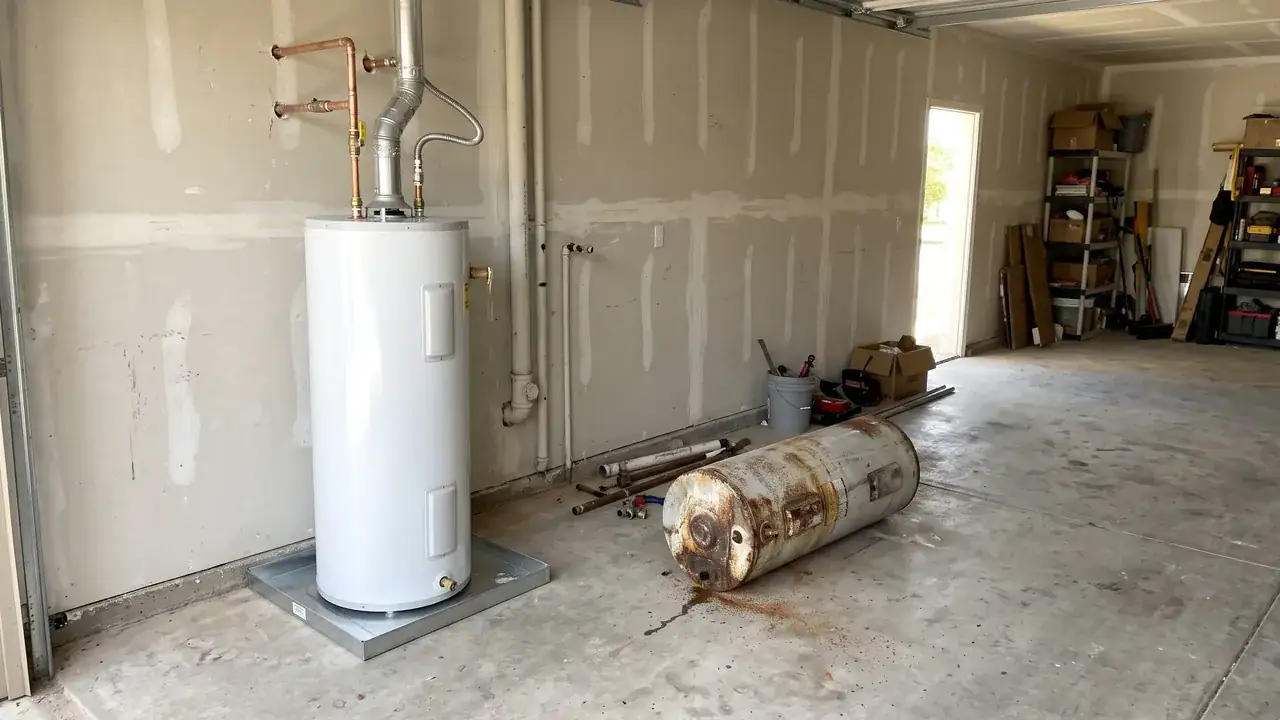
Replacement makes sense when the tank itself has failed or is close to it. A tank that weeps from the bottom seam, rusts at the fittings, or leaves rust-brown water at the tap has lost the steel that holds water in. No part fixes that. Age is the second trigger: a standard tank in DFW hard water commonly runs 8 to 12 years, and a heater past 10 that needs a gas control valve or a pair of elements is usually the wrong place to spend money. The reasoning is laid out further in how long water heaters last here.
Repair is the better call when the tank is sound and the failed part is cheap: a thermocouple, a thermostat, a heating element, a T&P valve, a dip tube. A rough rule that holds up in practice is to compare the repair quote with about one third of a replacement quote. Under that, and the heater is under 8 years old, repair. Over it, or the tank is older, replace.
| What you see | Heater age | Usual call |
|---|---|---|
| Water at the base that traces to the tank, not a fitting | Any | Replace |
| Rust-colored hot water only, cold is clear | 8+ years | Replace |
| No hot water, failed element or thermostat | Under 8 years | Repair |
| Pilot will not stay lit, thermocouple is bad | Under 10 years | Repair |
| Loud rumbling from sediment, heavy scale | 10+ years | Replace, or flush if the tank is young |
| Second repair within a year | 8+ years | Replace |
Sizing: 40, 50 or 75 gallons for a DFW household
Most 1990s and 2000s subdivisions around Carrollton, Plano and Frisco were built with 40-gallon heaters in the closet or attic for the standard bath count. Families have grown into those houses. A 50-gallon unit is now the common swap because it fits the same footprint in most closets with a slightly taller body, and the recovery rate on a gas model keeps up with a second shower.
Go to 75 gallons when you have a soaking tub, three or more full baths, or teenagers on staggered schedules, and the space allows it. Seventy-five gallon tanks are taller and wider, often 24 inches across or more, so a tight closet or attic platform may not take one. For electric, the first-hour rating on the yellow EnergyGuide label matters more than the gallon count.
| Tank size | Typical household | Where it fits |
|---|---|---|
| 40 gallon | 1 to 3 people, 1 to 2 baths | Closets, townhomes, condos |
| 50 gallon | 3 to 5 people, 2 to 3 baths | Most garage and attic platforms |
| 75 gallon | 5+ people or soaking tub | Garages, utility rooms with clearance |
Attic, garage and closet swaps are different jobs
Attic installs are everywhere in DFW homes from the 1990s and 2000s, built that way to save floor space on slab foundations. Replacing an attic heater means carrying a 100-pound tank up a pull-down stair or a scuttle hole, working on a plywood platform in summer heat, and setting a new drain pan with a drain line that reaches an outside termination. Expect the labor line to run higher than a garage swap.
Garage heaters carry their own rules. The ignition source on a gas unit has to sit at least 18 inches above the floor, which usually means a platform, and a flammable-vapor-resistant (FVIR) design is standard on new gas tanks. A closet unit is the simplest swap, but check combustion air and the vent connector, since an old closet vent may no longer meet code.
- Attic: pan, drain line, platform condition, access size, ceiling below
- Garage: 18-inch base, vehicle protection, FVIR rating, sealed burner
- Closet: combustion air louvers, clearance around the draft hood
- Slab homes: lines run overhead, so a leak shows in the ceiling, not the floor
What a same-day swap involves
A straightforward replacement fits inside one half-day. The sequence below is the normal order for a tank swap with no surprises.
- Confirm fuel, tank size, location and venting; check the permit requirement for your city.
- Shut off the gas or breaker, close the cold inlet, and drain the old tank to a safe location.
- Disconnect the water lines, gas line or electrical whip, vent connector and T&P discharge.
- Remove the old tank and set the new one on the platform or pan, leveled and clear of combustibles.
- Fit new flexible connectors, a dielectric or brass nipple set, a new T&P valve or discharge pipe as required, and a thermal expansion tank where the system is closed.
- Leak-test the gas joints, light the burner or energize the elements, and verify draft, temperature and relief-valve routing.
- Haul the old tank out and, where a permit was pulled, leave it ready for inspection.
Permits and code items that come with replacement
A like-for-like tank swap is a permitted job in most DFW cities, and the licensed plumber normally pulls it. Texas licenses plumbers through the State Board of Plumbing Examiners (TSBPE), and the permit ties the work to a master plumber of record. Code details vary a little by city because each adopts its own edition of the plumbing and fuel gas codes with local amendments, so the permit office is the final word.
Replacement is also the moment old shortcuts get corrected: a missing drain pan in an attic, a T&P pipe that ends in the attic space, no expansion tank behind a pressure reducing valve, an undersized gas line, or a vent connector with the wrong slope. The full set of rules is in the DFW code and permit guide.
Tank, tankless or hybrid at replacement time
A standard tank is the lowest-cost swap and the default for most homes. A tankless gas unit gives endless hot water but usually needs a larger gas line, new venting and sometimes a different mounting location, which raises the project price; the particulars are in tankless installation. A hybrid heat pump water heater uses roughly a third of the electricity of a resistance tank and works well in a garage or large utility room, because it cools the air around it and needs breathing space and a condensate drain.
The federal credit rules changed for 2026, so do not plan a purchase around a federal credit without checking the current guide on 2026 water heater credits.
| Type | Typical installed range | Notes |
|---|---|---|
| 40–50 gal gas or electric tank | $1,400–$2,800 | Attic or code work pushes the top end |
| 75 gal tank | $2,200–$3,600 | Larger platform, heavier lift |
| Gas tankless | $3,800–$7,500 | Gas line and vent changes are the swing items |
| Hybrid heat pump | $2,800–$4,800 | Needs air volume and a drain |
What drives the price at your house
The heater is only part of the number. Location, access, code corrections, the fuel and the model drive the rest. For the full breakdown, see replacement cost in DFW. A first-floor closet swap of a mid-grade 50-gallon gas unit sits near the low end; an attic electric with a new pan, drain line and expansion tank sits near the high end.
Freeze and hard-water lessons for the new unit
February 2021 split pipes across Dallas–Fort Worth and cracked fittings on many attic and garage heaters. If your heater lives in an exposed space, insulate the supply lines and the first few feet of pipe, and learn where the main shutoff is before the next hard freeze.
DFW water is hard, which is why a new tank benefits from yearly flushing and an anode-rod check at about year three. Manufacturers also list descaling for tankless units, and a tank that is never drained will lose capacity to sediment long before it leaks.
Before you call: quick answers
What is a fair price to replace a water heater?
In DFW expect roughly $1,400 to $2,800 installed for a standard 40 or 50-gallon tank in 2026, with fuel type, access and code fixes moving the number. Attic installs and tankless conversions cost more. Treat these as typical ranges, not quotes, because each house differs.
Is it worth it to repair a hot water heater?
It is worth repairing when the tank is sound, the heater is under about 8 to 10 years old, and the repair costs well under a third of replacement. A leaking tank or a second major repair within a year points to replacement instead.
How long does a water heater replacement take?
A like-for-like tank swap in an accessible closet or garage usually takes two to four hours. Attic jobs, new venting, gas line changes or a tankless conversion can stretch to a full day, and the city inspection may follow afterward.
Do I need a permit to replace a water heater in DFW?
Most DFW cities require a plumbing permit for a water heater replacement, and a licensed plumber normally pulls it. Rules differ by city, so the local permit office has the final word. Homeowners in their own homestead may pull permits in some cities.
Should I go from a 40-gallon to a 50-gallon tank?
Usually yes if it fits. A 50-gallon tank costs little more, fits most closets and platforms, and gives a family of four more first-hour capacity. Measure the height, diameter and vent clearance first, especially in attic and tight closet installs.
Can I switch from gas to electric, or tank to tankless, when I replace?
Yes, but a fuel or type change adds work. Going electric needs a 240-volt circuit sized to the unit, and tankless usually needs gas line upsizing and new venting. Same fuel, same location is the cheapest path and the fastest.
What happens to the old heater?
The plumber drains it, disconnects it and hauls it away as part of the job. Metal tanks are recycled. If a permit was issued, the new installation stays accessible until the city inspector has seen the work.
Get a person, not a form.
Call, give your ZIP, and describe what the heater is doing.