Electric Water Heater Repair in Carrollton and North DFW
- Licensed Texas plumbers
- Gas and electric, tank and tankless
- Same-day visits when the schedule allows
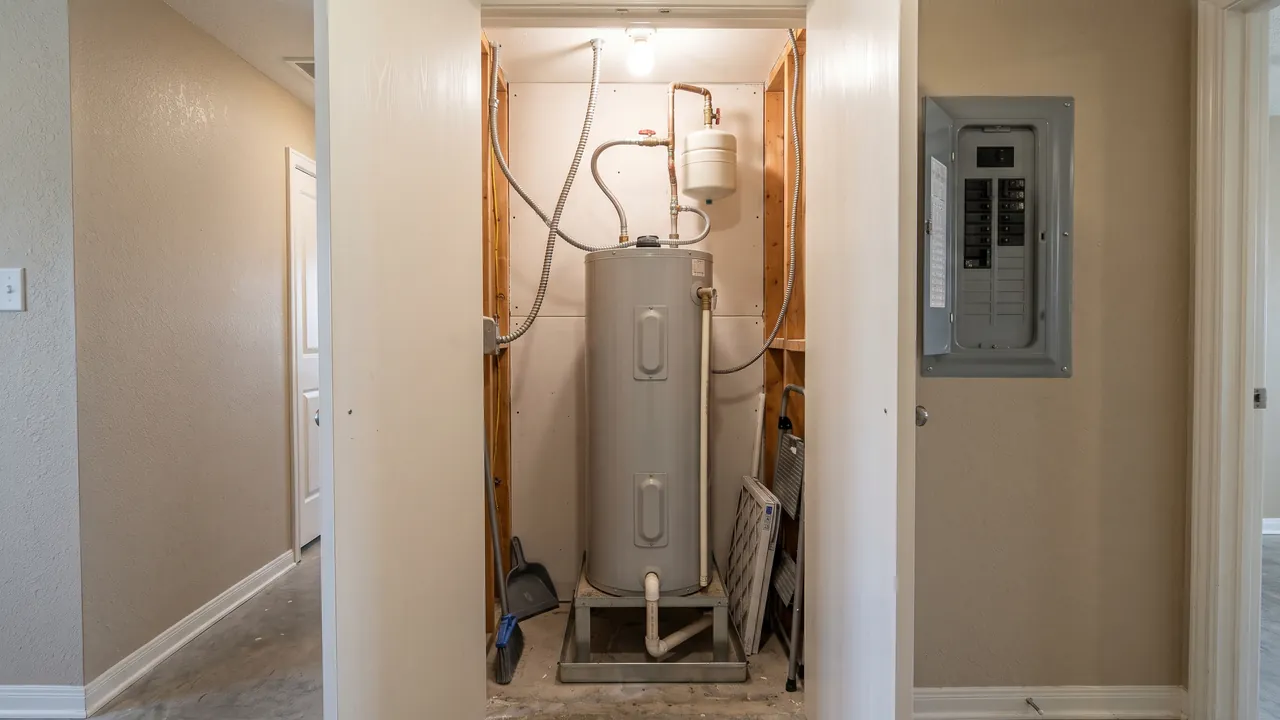
How a tank-style electric heater actually makes hot water
A standard residential electric tank has two screw-in or bolt-flange heating elements, one near the top and one near the bottom, each controlled by its own thermostat. Most are 4,500-watt, 240-volt elements. The upper thermostat gets priority: it heats the top third of the tank first, then hands power to the lower element to bring the rest of the water up to temperature. The two elements are designed not to run at the same time, which is why a single heater can live on one 30-amp circuit.
That sequence explains most symptoms. When the upper element or upper thermostat dies, you get no hot water or only lukewarm water, because the lower element never receives power. When the lower element dies, the tank still produces hot water, but only a fraction of its rated volume, so showers run out fast. Knowing which half of the heater has failed cuts the diagnosis down to two parts instead of six.
Symptom, cause and fix
Use the table as a first pass before anyone opens an access panel. It lists the faults that show up most often on electric heaters in North Texas homes, apartments and townhomes.
| Symptom | Likely cause | Typical fix |
|---|---|---|
| No hot water at all | Tripped ECO high-limit, dead upper element, failed upper thermostat, or no power at the breaker | Reset ECO once; test power and element resistance; replace the failed part |
| Lukewarm water, never fully hot | Upper element burned out or lower thermostat stuck | Replace the element or thermostat after a continuity test |
| Hot water runs out in a few minutes | Lower element failed or buried in sediment | Flush the tank, replace the lower element |
| Breaker trips as soon as it is reset | Element grounded to the tank wall or a shorted thermostat | Isolate and test each element; replace the shorted part |
| Rust-coloured hot water | Anode depleted and the tank liner corroding | Inspect the anode; replace the heater if the tank wall is compromised |
| Water pooling under the tank | Leaking element gasket, fitting, or the tank itself | Replace the gasket if only the flange leaks; replace the tank if it is the shell |
ECO reset: what the red button really means
Behind the upper access panel sits a red reset button on the upper thermostat. It belongs to the energy cut-off (ECO), a high-limit safety that opens the circuit when the water near the top of the tank passes roughly 170°F. A reset is reasonable once. If the button trips again within days, something is driving the water past its limit, usually a thermostat that is welded shut or an element that has shorted, and repeated resetting only masks that fault.
Cut the breaker and confirm the power is dead with a tester before removing the panel and the insulation. A 240-volt heater keeps both legs live, so touching one terminal with the breaker on is enough to be hurt.
Breaker size and wire gauge
A 4,500-watt element at 240 volts draws about 18.75 amps. Electrical code treats a water heater as a continuous load, so the circuit is sized at 125 percent of that figure, which lands at roughly 23.4 amps and rounds up to a 30-amp double-pole breaker. Copper 10 AWG cable is the standard match for that breaker. A 5,500-watt element draws about 23 amps and still fits on the same 30-amp, 10 AWG circuit.
Problems appear when a heater is moved to an older run. Some 1970s and 1980s apartments around Dallas County were wired with 12 AWG on a 20-amp breaker, which cannot carry a standard element safely. Replacing the breaker with a larger one without changing the wire is a fire hazard, and a licensed plumber will stop and have the circuit corrected instead. A heater that keeps tripping a correctly sized breaker is almost always reporting a bad element, not a weak breaker.
Dry-firing: the fastest way to ruin a new element
An element has to be submerged whenever it is energized. Powered in open air, a new element can burn out in seconds, and if it is left that way, it can damage the thermostat and the surrounding insulation. The common mistake happens after a drain: the tank is flushed or an element is swapped, the breaker is switched on before the tank is full, and the new part dies immediately.
Open a hot tap upstairs and let the tank fill until water runs steadily with no sputtering air, then restore power. That order protects the element.
Hard water, scale and burnout
North Texas tap water is moderately hard to hard, and the exact figure shifts by city, treatment plant and season; each supplier's annual water-quality report lists the current number. Heat drives calcium and magnesium out of solution, and the lower element is where it collects. A crust a quarter-inch thick insulates the element from the water, so it runs hotter than designed and burns out early. Sediment also settles over the lower element and makes the heater take longer to recover.
A tank that has gone five or six years without a flush often delivers a lower element that cannot be unscrewed without damage. If you want the full picture of what DFW minerals do to heaters, the hard water guide covers it, and the maintenance page gives a flush calendar.
Checking an element and thermostat the way a plumber does
- Turn off the breaker and verify no voltage at the upper thermostat terminals.
- Remove the access panel and insulation, then check that the ECO button is not tripped.
- Disconnect one wire from each element and measure resistance. A healthy 4,500-watt element reads in the neighborhood of 12 to 13 ohms; an open reading means a burned-out element, and a reading to the metal tank shows a ground fault.
- Test thermostat continuity and compare its setting to the label, typically 120°F.
- If a part is replaced, fill the tank completely before restoring power, then confirm amp draw and recovery.
All-electric homes, apartments and townhomes in DFW
Electric tanks are the default in many apartment complexes, condos and townhomes along the Belt Line, Josey Lane and Midway corridors, where running gas piping to every unit was never part of the plan. Newer slab-on-grade subdivisions in Frisco, Little Elm and The Colony also include all-electric builds. Electric service in most of the area comes from Oncor's wires, with CoServ serving parts of the northern edge, and the retail provider you pick determines the per-kilowatt-hour price rather than the repair.
Where the heater lives matters. In an apartment, it often sits in a closet beside the air handler with a drain pan and a stub of 3/4-inch drain line. In a single-family home, it may be in the garage or attic, where summer heat can age thermostats and wiring faster than a conditioned closet would. Attic units need a drain pan, a proper pan drain and an accessible service path, and many city codes require them.
Repair or replace an electric tank
Element and thermostat jobs are cheap compared with a new tank, and in a heater under about eight years old they are almost always worth doing. A leak from the tank shell, rust at the base of the jacket, or sediment so thick the elements will not come out points the other way. Electric tanks tend to run 10 to 15 years in DFW, a little less in untreated hard water, so a unit past the decade mark with a second major repair coming is a better candidate for replacement.
Typical DFW pricing, a range and not a quote: an element runs about $150 to $300, a thermostat about $150 to $350, and a full set of both thermostats and elements near $350 to $600.
Before you call: quick answers
How do I reset an electric water heater?
Switch the breaker off, remove the upper access panel and insulation, then press the red ECO button on the upper thermostat once and replace the cover. Restore power and wait about an hour. If the button trips again, a shorted element or stuck thermostat is the real fault and needs testing.
Why does my electric water heater keep tripping the breaker?
A heating element grounded to the tank wall is the most common reason, followed by a shorted thermostat or damaged wiring. Scale accelerates the failure on the lower element. A plumber can isolate each part with a meter in minutes, so you replace only what has actually failed.
What size breaker and wire does an electric water heater need?
Most 4,500-watt tanks use a 30-amp double-pole breaker with 10 AWG copper wire. Always follow the nameplate on your heater and the local electrical code. Installing a bigger breaker on thinner wire is dangerous, so a mismatch has to be corrected at the circuit.
Can I replace a heating element myself?
It is possible with the right tools, but the risks are real: 240-volt wiring, a tank that must be drained, and elements that dry-fire in seconds if power returns before the tank is full. Texas plumbing rules and permit requirements also apply, so many owners hand this job to a licensed plumber.
Why do I get hot water for only a few minutes?
That pattern normally means the lower element has failed or is buried in sediment, leaving only the top section of the tank heated. Draining the tank and testing the lower element confirms it. Hard water scale in North Texas is the typical underlying cause.
How long do electric water heater elements last?
Elements often last five to ten years, but hard DFW water shortens that when the tank has not been flushed. A tank flushed every year tends to outlast one that never has. The tank itself usually lasts 10 to 15 years before the liner and anode give out.
Is an electric tank cheaper to run than gas in Texas?
Usually not. Electric tanks cost less to buy and install, but on a typical Texas electric rate they cost more per year to operate than a gas tank on Atmos Energy service. Heat pump models change that math and are covered on the heat pump water heater page.
When should I replace instead of repair?
Replace when the tank shell leaks, the unit is past roughly 12 years, or repairs approach half the cost of a new heater. Repair when the heater is young and the fault is an element, thermostat or breaker issue that testing can pinpoint.
Get a person, not a form.
Call, give your ZIP, and describe what the heater is doing.