Water Heater Leaking: What to Check and What to Shut Off
- Licensed Texas plumbers
- Gas and electric, tank and tankless
- Same-day visits when the schedule allows
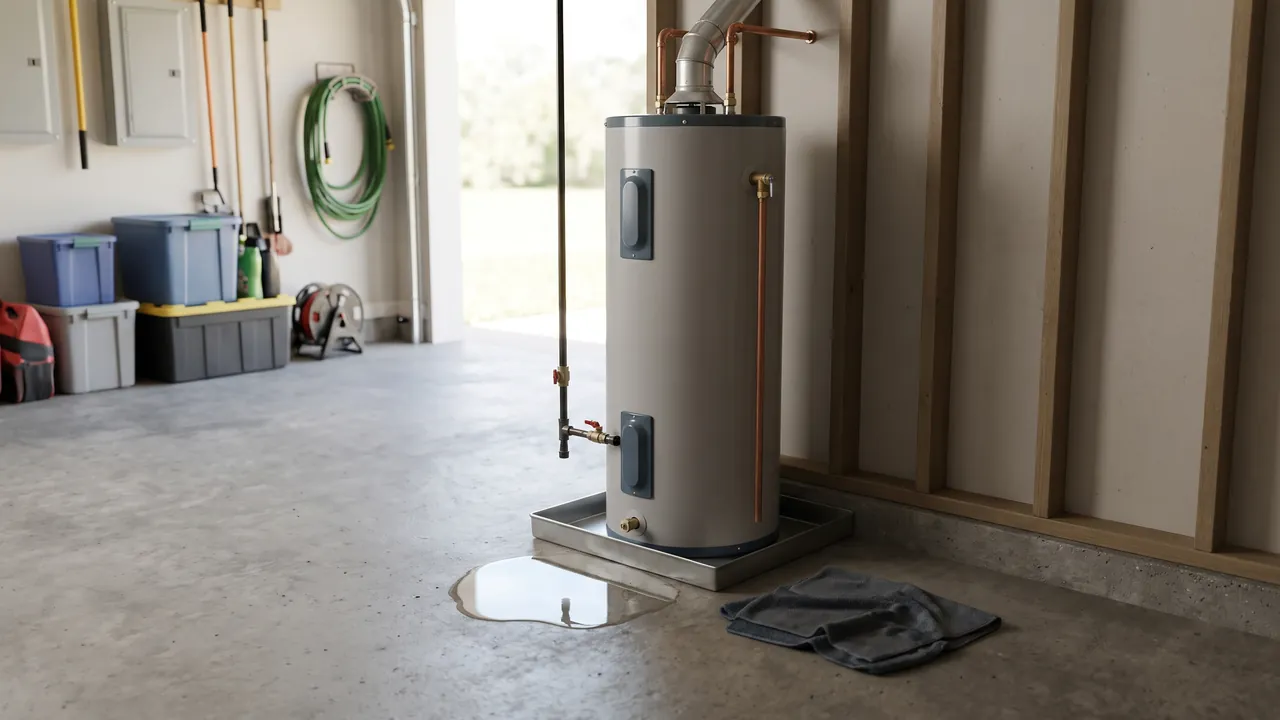
First five minutes: the shutoff order
Order matters, because a heating element or burner running against a draining tank can burn out, and the cold-water valve controls how much water keeps arriving.
- Electric heater: switch off the breaker. Gas heater: turn the gas control to off, or to pilot if the dial offers only that, and close the gas shutoff valve if it is within reach.
- Close the cold-water inlet valve on the pipe above the tank, turning it clockwise until it stops.
- Open a hot tap somewhere in the house so the tank does not pull a vacuum and the leak slows.
- If the leak is heavy, attach a hose to the drain valve and run it to a floor drain or outdoors; let the tank empty.
- Take photos before cleanup, then mop and place towels or a wet vac. In an attic, check the ceiling below for staining.
Where the water is coming from
Leaks look similar but come from different places, and the location tells you whether the heater is finished. Trace the water upward with a dry paper towel, because it runs down the tank and pools at the bottom no matter where it starts.
| Source | What it looks like | Usual fix |
|---|---|---|
| Top fittings and nipples | Drips or white and green crust at the inlet and outlet | Tighten or replace fitting or nipple |
| T&P valve or discharge pipe | Steady drip from the valve or pipe end | Replace the valve; check house pressure and expansion tank |
| Drain valve at the base | Weep from the spigot or its threads | Close tight, add cap, or replace the valve |
| Bottom or side of the tank | Water from the tank jacket, rust streaks, wet insulation | Replace the heater |
| Condensation | Light moisture on cold pipes or a high-efficiency unit's vent | Wipe and monitor; check for drain or vent issues |
| Drain pan | Water in the pan with a dry tank | Find the source above; clear the pan line |
| Gas unit combustion | Moisture at burner area in a new, cold start | Usually temporary; check venting |
What to do if it leaks from the bottom
A leak at the bottom is usually the end of the tank. Rust has eaten through the inner steel lining or a weld, and no patch holds under the heat and pressure of a working tank. Before concluding, rule out the drain valve, the T&P discharge and the pan line, all of which can mimic a bottom leak and are cheap to fix.
Check whether the wetness appears only after the heater runs, which can also point to thermal expansion in a closed system. Expansion forces water past the T&P valve and shows up as a steady drip from the discharge line, not the tank. An expansion tank cures that, as described in expansion tank installation.
How long a leaking tank lasts
A leaking fitting can drip for months. A leaking tank is different, and there is no safe timetable. Some seams weep slowly for days; others let go suddenly and empty 40 or 50 gallons. The tank body cannot heal itself, and corrosion at one pinhole widens with time.
Treat a confirmed tank leak as an immediate replacement. Shut off water at the heater, drain it and decide with the plumber whether the home can run without hot water until the swap. The repair-versus-replace guidance on water heater replacement covers the next step.
Attic heaters and slab homes
Many DFW homes from the 1990s and 2000s have the heater in the attic, above a bedroom or hallway ceiling. A slow leak there can stain drywall for weeks before anyone sees it, and a burst can bring down the ceiling. The drain pan and its line are the early warning; a pan that holds water is a sign the heater leaks. Check the ceiling below and the pan line outlet at the eave.
Slab homes route supply lines overhead or through the slab. A heater on the ground floor leaks onto the floor, which shows quickly, but hidden leaks under the slab appear as a hot spot on the floor or a spinning water meter with every fixture off.
Photos, mold and insurance
Photograph the heater, the label with the model and serial number, the leak source and the damage before you clean up. Most Texas homeowner policies respond to sudden and accidental water discharge and not to long-term seepage or the failed heater itself, though terms differ, so read your policy or ask your agent before throwing anything away.
Dry wet drywall and insulation within a day or two, because mold can start within a couple of days. Wet insulation in an attic should be removed and replaced rather than dried in place.
Freeze and hard-water leaks
Sediment from DFW hard water can foul the drain valve and the T&P valve, so a valve that was never exercised leaks when it finally opens. After a hard freeze, check the pipes and fittings around the heater for cracks as they thaw, as happened across the region in February 2021.
Before you call: quick answers
What do you do if your water heater is leaking from the bottom?
Shut off the power or gas, close the cold-water valve and drain the tank to a safe spot. Water from the base generally signals a tank that has rusted through. First rule out the drain valve and the T&P discharge, then plan for a replacement.
How long will a water heater last once it starts leaking?
A fitting leak can last months, but a tank leak is unpredictable, from days to a sudden failure. The steel does not heal, and the leak enlarges as corrosion spreads. Plan on replacing the heater promptly instead of waiting.
Should I turn off the water heater if it is leaking?
Yes. Turn off the breaker or gas first, then close the cold-water inlet. This stops heating an emptying tank and limits the water that enters. Open a hot tap to relieve pressure, and keep the shutoff valve location handy.
Can a leaking water heater be repaired?
If the leak is at a fitting, nipple, drain valve or T&P valve, yes. If water comes from the tank jacket or seam, no. Repair cost is usually a fraction of replacement, so locating the source properly decides the outcome.
Why is my water heater T&P valve dripping?
It is releasing pressure or heat. Common causes are thermal expansion in a closed system, house pressure that is too high, or a worn valve. An expansion tank and a pressure check usually fix it; replacing only the valve may not.
Does homeowners insurance cover a leaking water heater?
Many policies cover sudden, accidental water damage but not the heater itself or long-term seepage. Terms differ, so photograph everything and read your policy or ask your agent before cleaning up.
Is it normal for a water heater to drip when it starts?
A little condensation can form when a cold tank first heats, especially on a gas unit, and it stops. Dripping that continues after the tank is warm points to a real leak and should be traced.
Get a person, not a form.
Call, give your ZIP, and describe what the heater is doing.