Tankless Water Heater Installation in Carrollton and DFW
- Licensed Texas plumbers
- Gas and electric, tank and tankless
- Same-day visits when the schedule allows
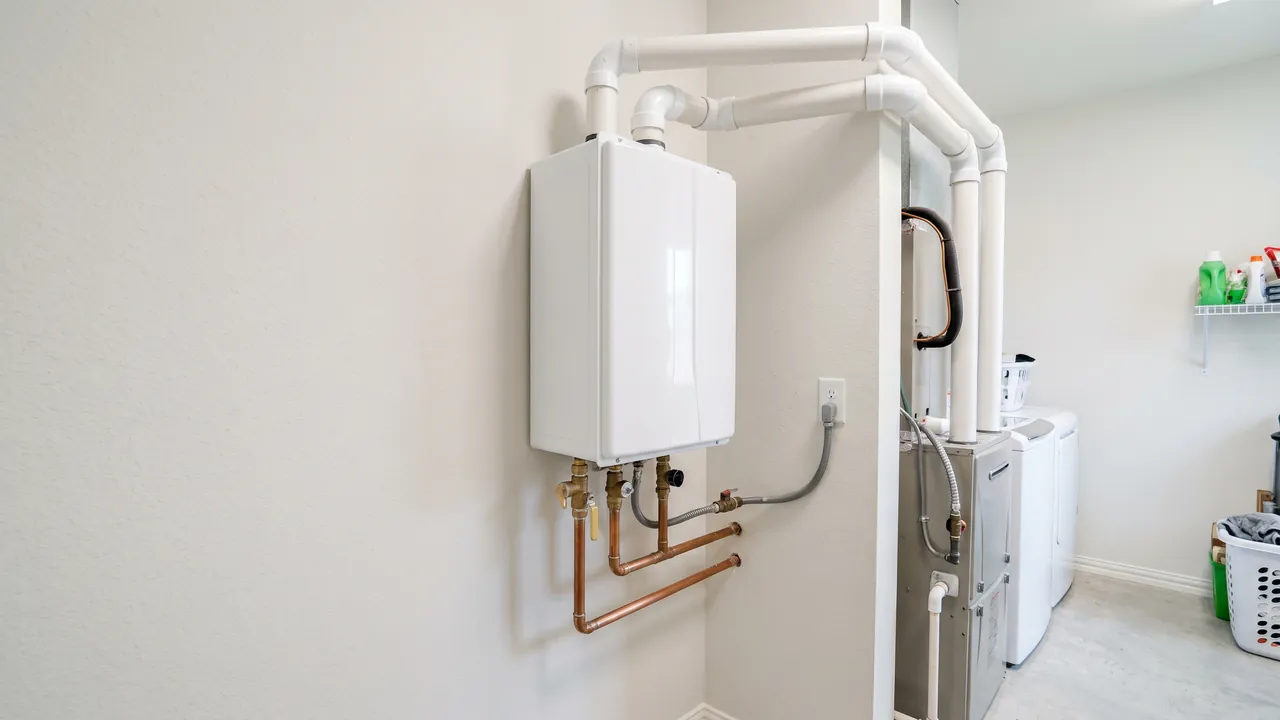
What changes when a tank becomes a tankless
A tankless heater fires only when water flows, so it must deliver the full temperature rise in a few seconds. That demand is why the install touches more than the water connections. A gas unit burns 150,000 to 199,000 BTU per hour at full fire, against 30,000 to 50,000 for a tank, and an electric whole-house unit can pull 100 amps or more.
In a typical 1990s or 2000s DFW house the old tank sits in an attic or garage with a draft-hood vent. A tankless replacement usually moves to an exterior wall or the garage wall, because the vent has to exit sideways or through the roof in stainless or plastic pipe. The cost of that relocation, plus new gas line and condensate routing, is the real price of the job.
Sizing worksheet: flow rate and temperature rise
Sizing starts with the flow you will use at the same moment, then the temperature rise from your incoming water to the setpoint. North Texas groundwater and lake supplies run cooler in winter than in summer, so size for the cold months. If incoming water is about 55 degrees in January and you want 120, the rise is 65 degrees.
| Fixture | Typical gallons per minute | Running together? |
|---|---|---|
| Shower, standard head | 2.0 to 2.5 | Add each shower in use |
| Kitchen faucet | 1.5 | Often with a shower |
| Bath faucet | 1.0 to 1.5 | Often with a shower |
| Dishwasher | 1.0 to 1.5 | Usually the evening |
| Washing machine (hot) | 1.5 to 2.0 | Weekend mornings |
| Soaking tub fill | 4.0 to 6.0 | Usually alone |
Reading the result
Add the flows that overlap at peak. Two showers plus a kitchen faucet is about 6.5 gallons per minute. A gas unit of 199,000 BTU delivers roughly 5.5 to 6 gallons per minute at a 65-degree rise and about 9 at a 40-degree rise, which is why the same heater feels strong in August and short in January. Output varies by model, so use the manufacturer's flow chart for the one being installed.
For electric the arithmetic is blunt: each gallon per minute at a 65-degree rise needs about 9.5 kilowatts. A single 2.5 gpm shower asks for roughly 24 kilowatts, or about 100 amps at 240 volts. Few older panels have that to spare, which makes point-of-use electric minis the realistic choice for a bath or a kitchen rather than the whole house.
Gas line and the Atmos Energy meter
Most tankless installs in DFW require a bigger gas line. The sizing depends on the total BTU load of the house, the pipe length from the meter, and the pressure at the appliance. A half-inch line that fed a 40,000 BTU tank seldom carries a 199,000 BTU heater plus a furnace and range, so the plumber reruns three-quarter-inch or one-inch pipe.
Atmos Energy owns the meter and regulator. When the added load is large, the plumber checks whether the existing meter can supply it, and an upgrade, if needed, is arranged through Atmos rather than done by the plumber. This is rare for a single tankless in a standard single-family home, but it comes up in houses with a pool heater, a second range or a generator.
Venting, condensate and electrical limits
Non-condensing tankless units use stainless steel vent pipe and run hotter, so they need clearances from combustibles. Condensing units pull more heat from the exhaust, vent in PVC, CPVC or polypropylene as the maker approves, and produce acidic condensate that must go to a drain, often with a neutralizer cartridge. Both types take combustion air from the room or from outside through a sealed pipe.
Electric tankless units need one to four double-pole breakers of 40 to 60 amps each, with wire sized to match. The service panel, not the heater, is usually the limiting factor. Oncor or CoServ supplies the power; the panel capacity inside the house decides whether the project is practical.
Hard water, scale and recirculation
DFW water is hard, and scale builds inside a tankless heat exchanger faster than most owners expect. Without descaling, flow slows, error codes appear and efficiency falls. Install isolation valves so the unit can be flushed with a descaling solution, and plan on a yearly flush in this area, more often if the water is unusually hard or you have no softener.
A recirculation loop keeps hot water ready at far fixtures but increases scale and energy use. Many tankless models have a built-in recirculating pump or a buffer tank; choose one to match how often you wait for hot water. See tankless repair for what scale looks like when it goes wrong.
When tankless is the wrong choice
Tankless is the wrong fit for houses with a small gas line that cannot be upsized economically, with electric service too small for the unit, with no wall route for a vent, or with owners who want the lowest first cost. It also disappoints when many fixtures run at once and the unit was sized for one. Short, frequent draws on cold days, such as brief rinse cycles, can trigger the cold-water sandwich effect.
Install sequence and permits
- Measure peak flow and incoming water temperature to choose the unit.
- Check gas pressure and size the new line, or verify panel capacity and wire runs for electric.
- Mount the unit, install isolation valves and, where used, a recirculation connection.
- Run the vent pipe to the manufacturer's clearances and connect the condensate drain and neutralizer.
- Pressure-test gas joints, fire the unit, set the temperature and verify flow and exhaust.
- Complete the permit inspection with the city, as required.
Before you call: quick answers
How much should it cost to get a tankless water heater installed?
Typical 2026 DFW installed prices for a gas tankless run about $3,800 to $7,500, with the high end from gas line upsizing, new venting and relocation. Electric units can be lower for the heater but higher for panel work. See tankless cost for the details.
Is there a tax credit for tankless water heaters in 2026?
The federal 25C credit lapsed with the 2025 tax year, which means a unit installed now does not earn it. State, utility or manufacturer rebates may exist. Check the current tax credit guide before relying on one.
Do I need a plumber to install a tankless water heater?
The state exempts homeowners from licensing on their own homestead, but the permit, the gas pressure test, the venting rules and the code do not go away, and combustion mistakes can hurt people. Most people hire a licensed plumber for gas and venting work, and a homeowner permit depends on the city.
Why are plumbers against tankless water heaters?
Many are not against them, but they caution about cost, gas line and vent upgrades, scale in hard water and callbacks from undersized units. A well-sized, flushed tankless works well. A unit installed without isolation valves or enough gas often becomes a repair call.
Will a tankless water heater save money in Texas?
It can save some energy because there is no standby loss, but savings are modest in a warm climate and rarely cover the extra install cost on their own. Endless hot water and floor space are the usual reasons people choose it.
Does tankless work in a power outage?
Not without backup power. Both gas and electric units need electricity for the control board and, on gas, the fan and ignition. A small battery backup or generator circuit can keep a gas unit running.
How often do I flush a tankless in DFW?
Plan on once a year for hard water, and sooner if flow drops or an error code appears. The manufacturer's manual gives the descaling method and solution. Isolation valves make the flush a short job.
Get a person, not a form.
Call, give your ZIP, and describe what the heater is doing.